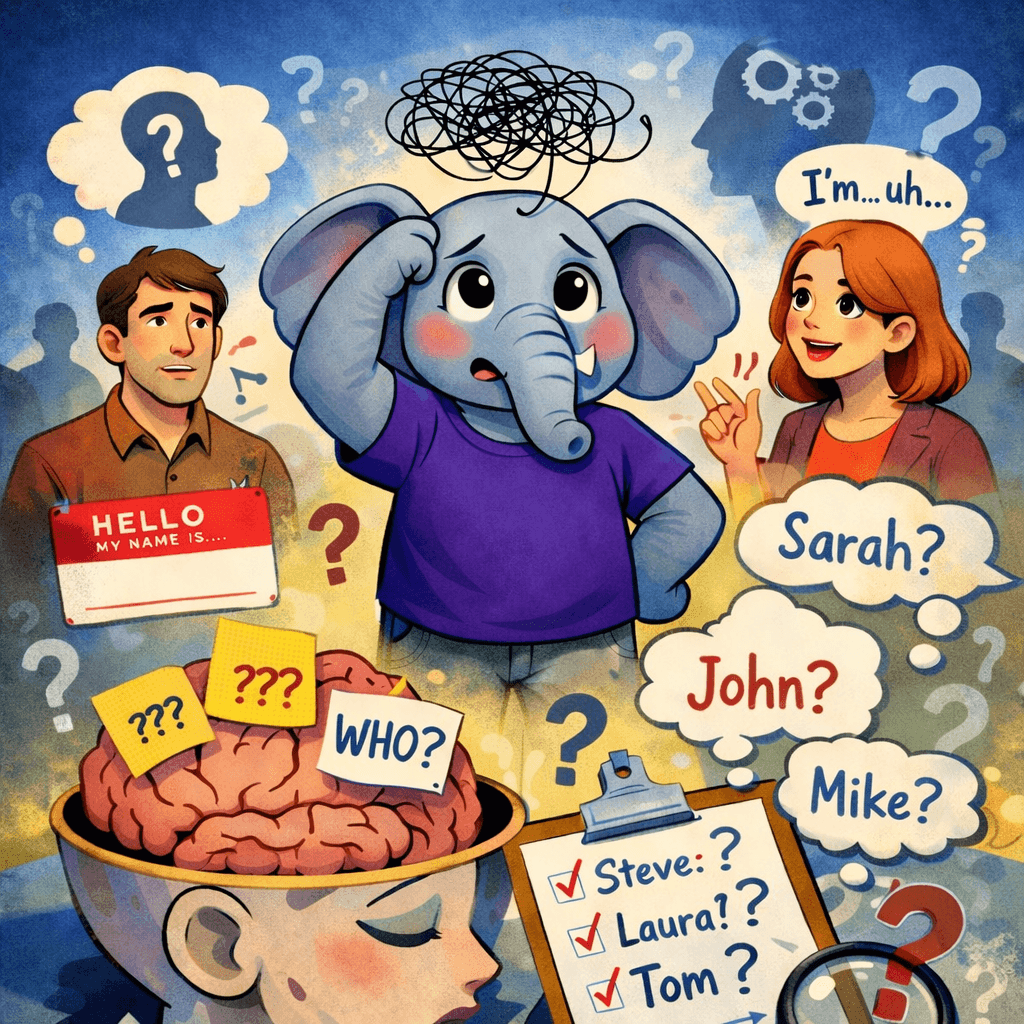
It's not the big things. It's the small ones.
When we talk about forgetting, we imagine names and birthdays. The obvious stuff.
But the things that actually slip are much more specific than that.
The problem is not remembering which of your friends has a gluten intolerance and which one has a nut allergy. It's forgetting how old someone's kids are, even though you've asked before. It's drawing a blank on whether your colleague studied architecture or engineering, even though you've had lunch together a dozen times. It's not being sure if the person you're about to mention is your friend's ex-husband or her brother.
It's the details that make people feel known. And when they slip, something quietly breaks.
Because here's the thing nobody says out loud: there's a limit to how many times you can ask.
You can ask someone's son's name once. Maybe twice. But the third time, you see it in their face. A flicker of something. Not anger, just a quiet registering of the fact that they didn't stick. That you didn't hold them.
So you stop asking. And instead you navigate around the gaps. You steer conversations away from the things you can't remember. You hope it doesn't come up. You become slightly less present in the relationship, not because you care less, but because the forgetting has made honesty too uncomfortable.
That's not a small thing. That's the slow erosion of closeness.
This happens with the people closest to you too
The easy assumption is that this is a problem with acquaintances. People you don't see often. Weak ties.
But that's not how it works.
It happens with your oldest friends. The ones you've known for fifteen years. Because closeness doesn't protect against cognitive overload. If anything, close relationships carry more detail, more history, more context to track. More chances for something to fall through.
A close friend mentions her mother is unwell. You make a note to ask next time. Next time comes and you're tired and distracted and it doesn't come up, and then enough time passes that bringing it up feels awkward. So you don't.
She never knew you forgot. But something still shifted.
That's what makes this particular kind of forgetting so painful. It's invisible. Nobody calls you out on it. There's no moment of reckoning. Just a slow accumulation of small absences that, over time, start to feel like distance.
Your brain was never built for this
Here's something that might make you feel a little less alone: your brain genuinely was not designed to hold what modern life asks it to hold.
Human memory evolved in small communities. We knew roughly 50 people, and we were physically near them most of the time. You didn't need to actively remember details about people. You were just always around them. Context did the work for you.
Today you might have 400 contacts in your phone, a team at work, a family spread across cities, old friends you see twice a year, a school group chat with 30 parents. Each of those relationships carries its own web of names, dates, histories, preferences, sensitivities and ongoing stories.
Your brain is running software from 70,000 years ago on 2026 demands.
And research on cognitive load tells us something important about how it fails: we don't lose the least important things first. We lose the most recent ones. The conversation from last week is more vulnerable than the habit from last year.
Which means the freshest, most alive details about people's lives, the things that matter most right now, are exactly the ones most likely to slip.
The guilt that follows you around
When you forget these things, the response isn't usually frustration. It's shame.
Because you know these people matter to you. You know you care. And yet you cannot produce their son's name, their job, the thing they told you three weeks ago, that you promised yourself you wouldn't forget.
So you start to wonder if you're a bad friend. A distracted partner. Someone who is too caught up in their own life to properly hold space for others.
You're not. You're just a person with one brain trying to maintain real, warm, attentive relationships with more people than any brain was built to handle.
The problem was never your character. It was always the gap between what you care about and what you can realistically remember.
What actually helps
I want to be careful here, because there's no magic fix for this.
Some of it is structural. Modern life asks too much of us, and that's worth naming.
But the memory piece, the specific weight of trying to hold the human details about everyone in your life, that is something that can be made lighter.
What helps is having somewhere to put things. Not a to-do list. Not a calendar. Something that holds the context for you. The names, the dates, the allergies, the family relationships, the conversations you want to follow up on. A quiet layer underneath your relationships that means your brain doesn't have to carry it alone.
The relief isn't just practical. It's emotional. When you trust that the details are held somewhere, you stop white-knuckling your way through conversations. You stop navigating around the gaps. You can just be present with the person in front of you.
Which is all you wanted in the first place.
A quieter kind of presence
I think about what I actually want underneath all of this.
Not a better memory. Just more room to be here.
To sit on the couch on a Tuesday evening and actually be there. To hear what my partner says the first time. To follow up with Marina not because I've set a reminder, but because I genuinely have the mental space to think about her.
Less noise = More presence = Better relationships
This is why we're building ai.elefant, a personal memory assistant that holds the human details about the people who matter to you, so your brain doesn't have to.