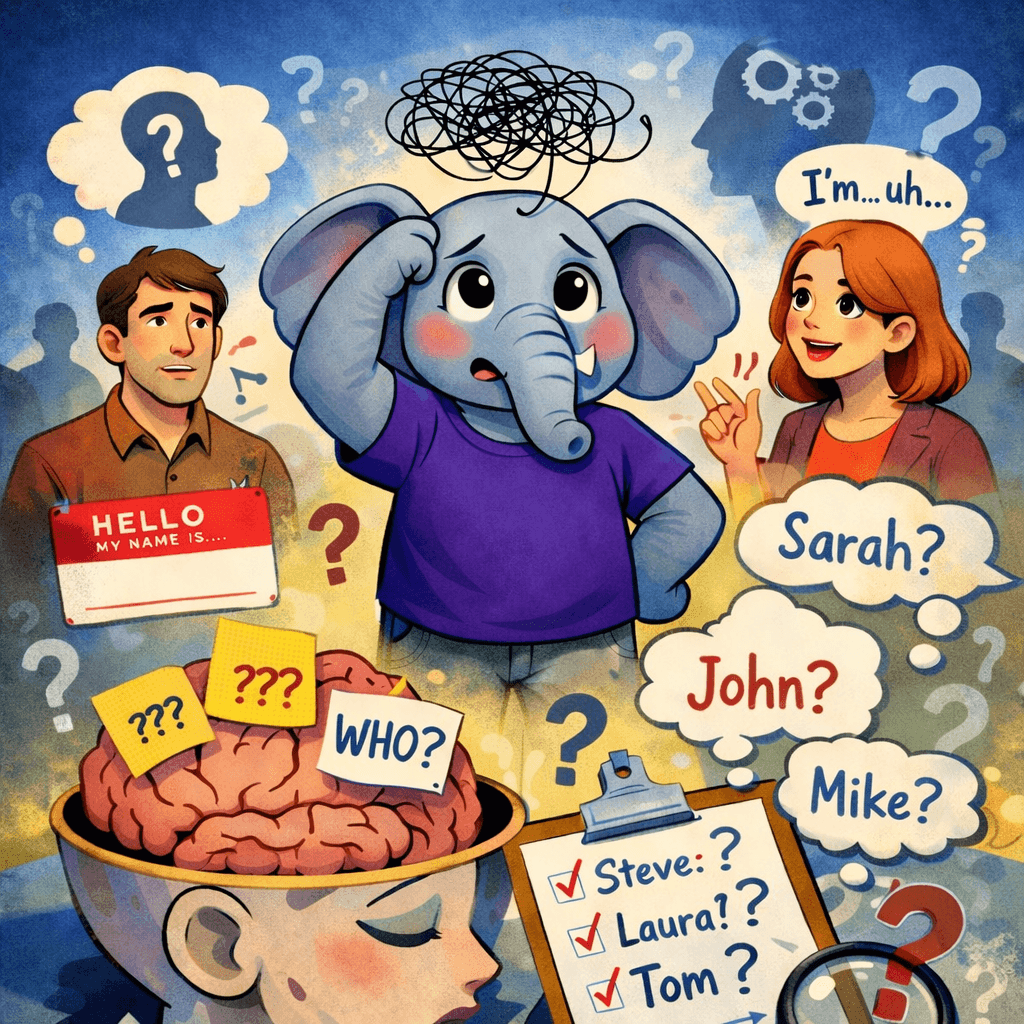
We have all been there.
You shake their hand, they say their name, you say yours and by the time you let go, their name is already gone. You knew it for about a second. Now you're nodding along, hoping someone else says it before you have to.
If you recognize that feeling, then you're not alone, and this article is for you. And if you never lose a name? Stay anyway, there is a good chance you will leave understanding why the rest of us do.
Being bad at remembering names is one of the most common complaints people have about their own memory. Yet it turns out to have very little to do with how good your memory is. Names are a special case: the brain treats them differently from almost everything else you learn about a person.
Names are a special case
Here is an experiment for you to run in your head. Is it easier to remember that someone is a baker than to remember their surname is Baker, even though it's the exact same word? Psychologists call this phenomenon the Baker/baker paradox. When the word means an occupation, it hooks into everything you already know: ovens, bread, flour, the smell of a bakery. When the same word is just a name, it hooks into nothing1.
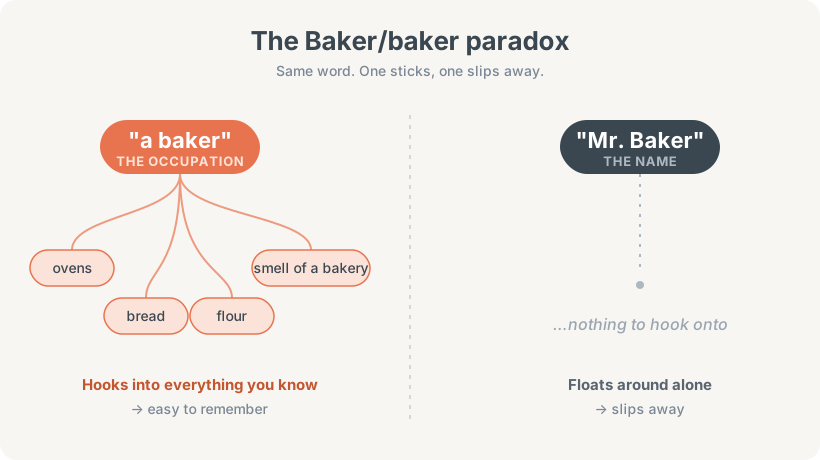
That's the heart of it. To your memory, a name is almost meaningless. When researchers looked at why we struggle to put names to faces, they found that people recall someone's job or where they live far more reliably than their name, because a name has no meaning to hook onto2. A face, a job, the story someone told you over dinner: each one connects to a web of things you already know. A name connects to nothing. It floats around alone.
That's why you can place a face instantly. "That's the guy from the marketing department." And still draw a complete blank on his name. Recognizing a face is your brain matching a pattern it has seen before. Producing the name is a different, harder action. You have to pull one specific, arbitrary label out of a storage with nothing to cue it. The face was never the problem. The name behind it was.
You were busy being nervous
There's another reason why names don't stick, and it has nothing to do with the name itself. When someone introduces themselves, you're usually thinking about a thousand other things. You might be preparing your own introduction, trying to keep eye contact, smiling, thinking about whether you should shake hands or hug and what to say afterwards, so there is no awkward silence. Your attention is pointed inward, and not towards them.
Psychologists documented this decades ago and called it the next-in-line effect. When people take turns speaking, they remember almost nothing said in the moments before their own turn3. It isn't that they stopped listening on purpose. The information simply never got encoded in their brain, because their attention had already slipped away to rehearse what they were about to say.
The original experiment put numbers on it. The recall was worst for whatever was said roughly 9 seconds before and after their turn to speak. For that short window, the words went in one ear and straight out the other, leaving almost no trace behind. And an introduction is that window in its purest form. Someone says their name at the exact moment you are bracing yourself to say yours, so of all the things they could have told you, their name lands in the moment where your memory is least able to catch it. You aren't being rude or careless. Your attention just quietly left the room to get ready for its own moment.
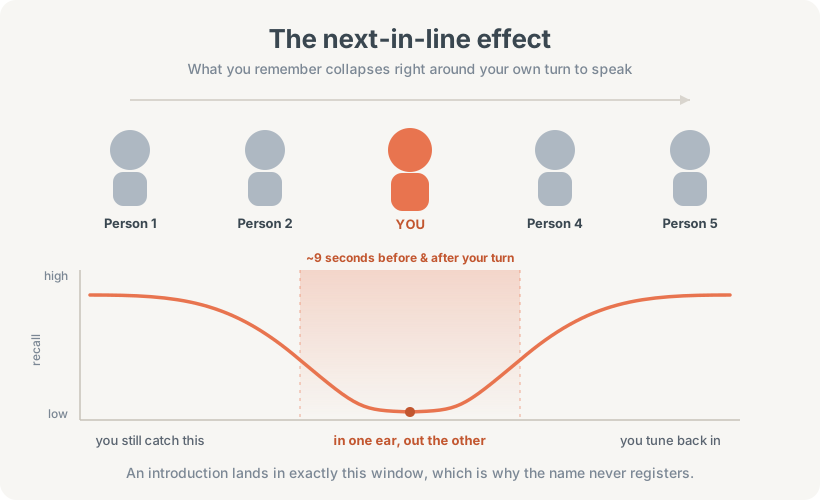
What makes this oddly reassuring is what the same research found next. When people were told in advance to pay attention to the moments before their turn, the effect mostly disappeared. The forgetting was never a flaw in your memory. It was just a question of where your attention happened to be pointing.
So, by consciously reminding yourself to pay close attention to the person currently speaking rather than mentally rehearsing your own turn, will help you remember what the person said.
Attention is where memory starts
Common for both of these phenomena is a simple principle: You remember what you process deeply, not what just passes through your ears. There is a classic framework for this, known as levels of processing: information handled at a shallow level, just the raw sound of a word, fades fast, while information processed for its meaning tends to last4.
A name, heard once in a noisy room while you were distracted, gets the shallowest treatment there is. You registered the sound and nothing else. So there is nothing to come back to later. Not because you "have a bad memory", but because the name was never encoded as anything more than a passing noise.
It is also why names slip more when you are tired, doing two things at once, or half glancing at your phone. Divided attention does not just make the encoding a little worse. At a shallow enough level, it barely happens at all. The name reaches your ears, but it never gets the chance to mean anything.
You didn't forget their name. You never really heard it.
So, what actually helps?
Yes, we know that we live in a world where we want the answers quickly and then continue the doom scrolling. So here you get the answers.
The good news is that the research points straight to what works. And luckily it does not require a special memory, we just need to give the name something to hold onto.
Say it back, out loud. "Nice to meet you, Yasmin". This forces you to process the name once more, on your own terms, after the nervous moment has passed. Just make sure that you say the correct name out loud 😅
Ask something about it. Ask how it's spelled? Where did it come from? A short story turns a meaningless sound into something that hooks, which is exactly what the Baker/baker paradox says is missing.
Attach it to meaning. Link the name to something you already know. Could be a friend with the same name, a movie, anything. You're manufacturing the associations the name doesn't come with.
Repeat it once, on a delay. Use it again a minute later, and also when you say goodbye to each other. Spacing the repetition matters more than the number of repetitions.
You've probably already noticed that all four work the same way. They slow down the moment just enough to actually process the name, instead of letting it slide past, while your attention is somewhere else.
And if one still slips, and let's be real, it probably will, then just be kind about it. Asking "Sorry, what's your name again?" a minute into a conversation will mostly be received as interest. People rarely remember that you forgot their name. However, they will remember that you cared enough to ask again.
The fifth way to remember
Even with the best habits and tricks, you will forget names and all the details that comes with them. The names of their kids, their job, their five cats at home. Holding all that information for everyone in your life is a real cognitive task, and your brain was never built to do that on this scale.
That's the idea behind ai.elefant: You shouldn't have to choose between being present with someone and remembering everything about them. You tell it the details once, and it remembers it for you, so next time you meet, the only job in front of you is to be there and enjoy the time with the people around you. No need to worry about getting their name right, because ai.elefant got you covered.
If that sounds like something you'd want, then sign up for the waitlist.
References
- Cohen, G. (1990). Why is it difficult to put names to faces? British Journal of Psychology, 81(3), 287–297. ↩
- Cohen, G., & Faulkner, D. (1986). Memory for proper names: Age differences in retrieval. British Journal of Developmental Psychology, 4(2), 187–197. ↩
- Brenner, M. (1973). The next-in-line effect. Journal of Verbal Learning and Verbal Behavior, 12(3), 320–323. ↩
- Craik, F. I. M., & Lockhart, R. S. (1972). Levels of processing: A framework for memory research. Journal of Verbal Learning and Verbal Behavior, 11(6), 671–684. ↩